

For questions, queries and comments contact us at
Site Designed & Maintained by
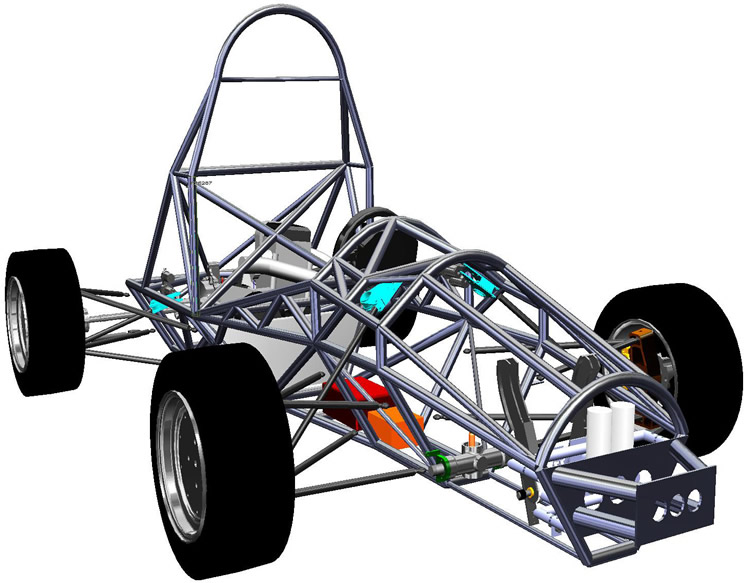
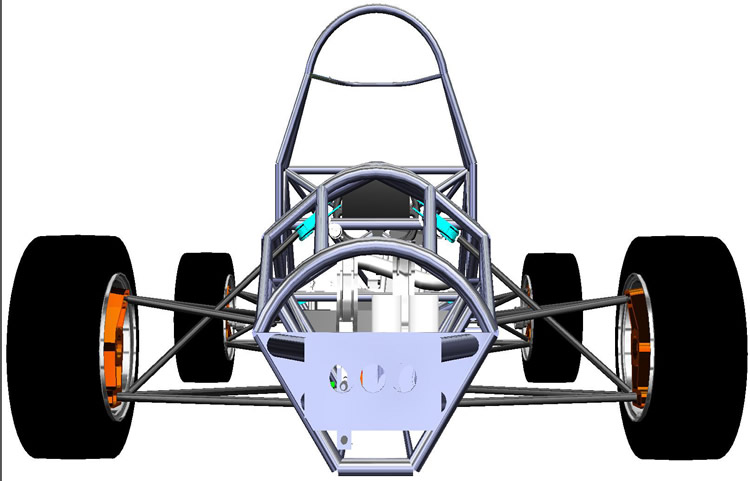
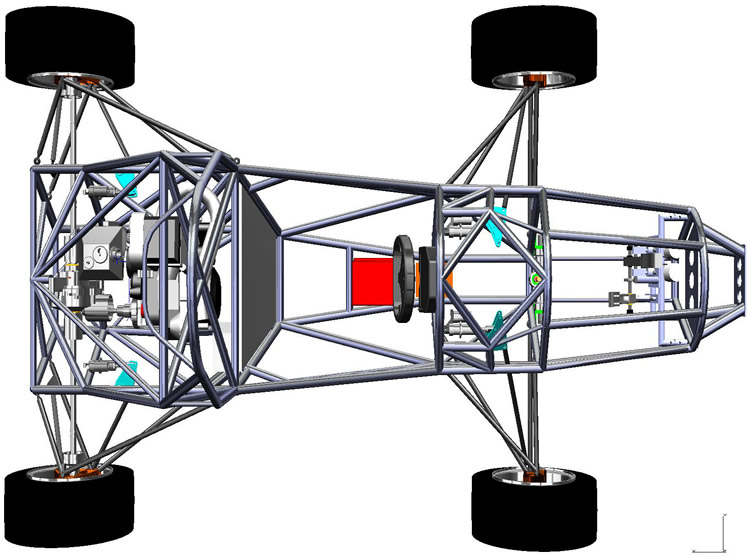
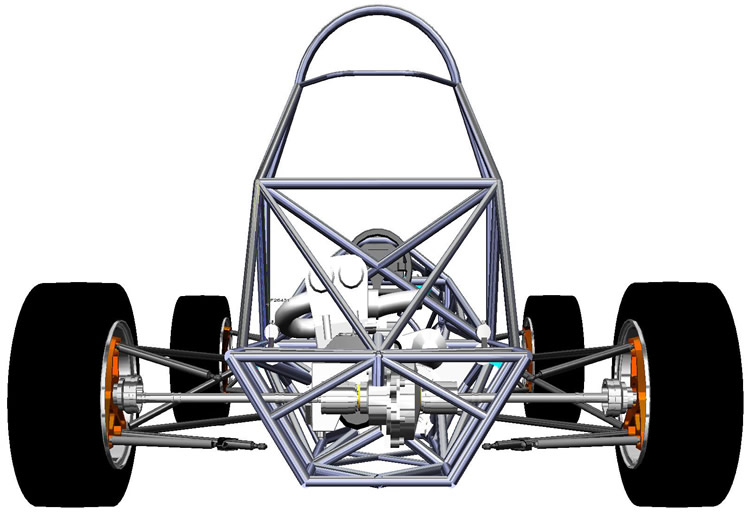
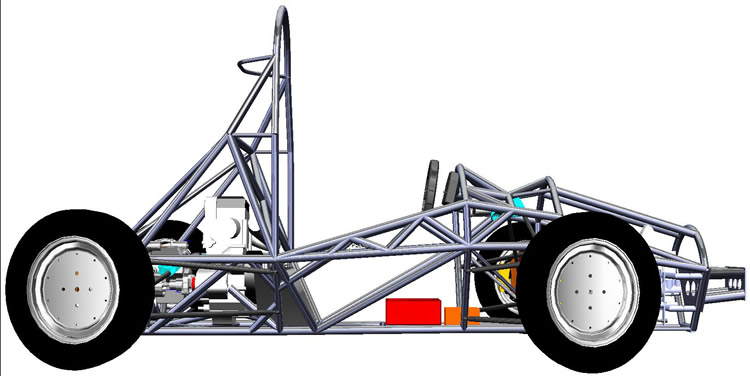
The BR-6 is the 2005 Formula Student car from Brunel University.The car uses a 2004 Yamaha WR450f engine, with custom intake andtwo point fuel injection.
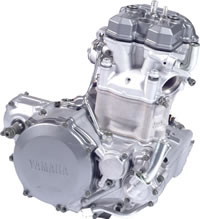
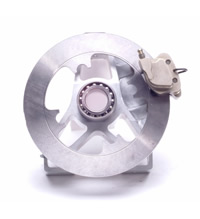
The engine is longitudinally mounted witha bespoke shaft drive running power through a Honda TRX500 quadlimited slip differential to 10" Keiser wheels with 16" o.d LeContracing slicks.
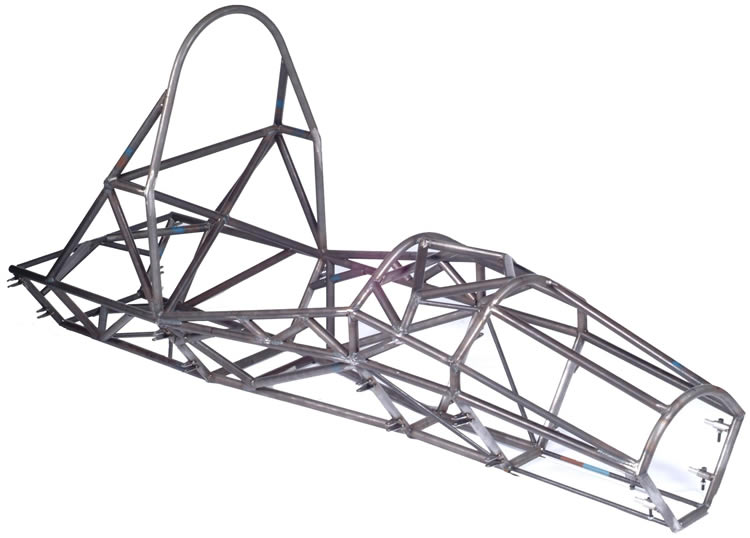
The 160kg challenger switches from the traditionalBrunel composite monocoque to a 35kg tubular steel spaceframe with6000Nm/degree of torsional stiffness.
| Front | Rear | |
|---|---|---|
| Overall (Length, Width, Height) | 2390mm, 1270mm, 1010mm | |
| Wheelbase | 1524mm | |
| Track | 1270 mm | 1270 mm |
| Weight with 68kg driver | 104.49 kg (full wet car weight of 180kg) | 138.51 kg (full wet car weight of 180kg) |
| Front | Rear | |
|---|---|---|
| Suspension Type | Unequal length A-Arms. Push rod actuated Fox Vanilla RC spring/damper units | Unequal length A-Arms. Push rod actuated Fox Vanilla RC spring/damper units |
| Tyre Size and Compound Type | 16x7.0-10 Medium White LeCont | 16x7.0-10 Medium White LeCont |
| Wheels | Keiser alloy 10" x 7" -63.5mm offset, 4mm thick 6061 aluminium | Keiser alloy 10" x 7" -63.5mm offset, 4mm thick 6061 aluminium |
| Design ride height (chassis to ground) | 50.8 mm | 50.8 mm |
| Centre of Gravity Design Height | 241.3 mm above ground, with driver | |
| Suspension design travel | 25.4 mm bump/ 25.4 mm droop | 25.4 mm bump/ 25.4 mm droop |
| Wheel rate (chassis to wheel centre) | 42.1 N/mm | 56 N/mm |
| Roll rate (chassis to wheel centre) | 1.0° / g | |
| Sprung mass natural frequency | 3.3Hz | 3.3Hz |
| Jounce Damping | 40% of critical damping at -127 mm/sec | 40% of critical damping at -127 mm/sec |
| Rebound Damping | 105% of critical damping at 127 mm/sec | 116% of critical damping at 127 mm/sec |
| Motion ratio | 1.5 : 1 | 1.38 : 1 |
| Camber coefficient in bump (deg / cm) | 0.4° / cm bump | 0.65° / cm bump |
| Camber coefficient in roll (deg / deg) | 0.6°/deg | 0.3°/deg |
| Static Toe and adjustment method | 0mm toe out adj. by track rods | 0mm toe in adj. by track rods |
| Static camber and adjustment method | 1.5°- by rod ends, at outboard wishbone | 1.5°- by rod ends, at outboard wishbone |
| Front Caster and adjustment method | 2.2° + non-adjustable | |
| Front Kingpin Axis | 4.4° + adjustable via outboard wishbone | |
| Kingpin offset and trail | 45 mm offset, 8 mm trail | |
| Static Akermann and adjustment method | Parallel Steer, adjusted at upright | Adjustment through track rod position |
| Anti dive / Anti Squat | 0% | 0% |
| Roll center position static | 27.5 mm above ground, CL of car | 78 mm above ground, CL of car |
| Roll center position at 1g lateral acc | 27.5 mm above ground, moves 11 mm toward inside wheel | 78 mm above ground, moves 14 mm toward inside wheel |
| Steer location, Gear ratio, Steer Arm Length | Front wheel steer, in line with lower A-arm andahead axle line, 4.35 - 6.75:1, 38mm | |
| Front | Rear | |
|---|---|---|
| Rotors | ||
| Master Cylinder | AP Racing CP2623 master cylinders (14mm internal bore front & rear) + Bias adjustment bar. | |
| Calipers | 2 x AP Racing CP4227 (4 piston) alumimium caliper | 2 x AP Racing CP4226 (2 piston) alumimium caliper |
| Hub Bearings | NTNDE0681, 2 row angular contact roller bearing | NTNDE0681, 2 row angular contact roller bearing |
| Upright Assembly | 6061 Aluminium, CNC machined single billet, integral caliper mounts | 6061 Aluminium, CNC machined single billet, integral caliper mounts |
| Axle type, size, and material | Live axle, aluminium 6085, rotary cut | Live axle, EN14 mild steel, milled |
| Driver Size Adjustments | Fixed seat and steering wheel. Pedal box adjustable to drivers requirements. |
|---|---|
| Seat (materials, padding) | Ethafoam panels with expanded foam core and nomex cover |
| Driver Visibility (angle of side view, mirrors?) | 105° visibility each side from straight ahead, rear view mirrors on cockpit sides |
| Shift Actuator (type, location) | L/H manual shifter, mounted to chassis rail. Cable linkage |
| Clutch Actuator (type, location) | Hand lever integral with shifter |
| Instrumentation | Datatool revlight, analog oil temp & pressure gauge, warning lights. |
| Frame Construction | Tubular space frame with stressed floor panel and seat back |
|---|---|
| Material | T45 alloy steel tube with aluminium panels |
| Joining method and material | TIG welded and rivited panels |
| Targets (Torsional Stiffness or other) | Optimised for mass to 6000 Nm/deg torsion |
| Torsional stiffness and validation method | 6000 Nm/deg torsion using GENESIS optimisation program |
| Bare frame weight with brackets and paint | 40kg including stressed panels |
| Crush zone material | Aluminium sheet and tubing with Ethafoam |
| Crush zone length | 155 mm |
| Crush zone energy capacity | 6027 kJ |
| Manufacture / Model | 2004 Yamaha WR450 single |
|---|---|
| Bore / Stroke / Cylinders / Displacement | 95.0 x 63.4 mm / 1 cylinder / 449 cc |
| Compression ratio | 12.5 :1 |
| Induction | Atmospheric induction |
| Fuel Type | 98 octane petrol (Shell Optimax) |
| Max Power design RPM | 10,200 rpm |
| Max Torque design RPM | 7,500 rpm |
| Min RPM for 80% max torque | 6200 |
| Fuel System (manf'r) | Student designed/built fuel injection system using MoTeC ECU |
| Fuel System Sensors | Magnetic crank trigger, Hall cam sensor, MAP, Water temp, Air temp, Throttle Pos, ?. |
| Fuel Pressure | 3 bar (static) |
| Injector location | Twin injectors, 1 on back of valve, 1 on throttle |
| Intake Plenum volume | 1.5 litre cylindrical body, 2.97 litre including taper from restrictor |
| Effective Intake Runner Length | 300mm |
| Exhaust header design | Stainless steel header |
| Effective Exhaust runner length | 500 mm header, ongoing testing to determine final length |
| Ignition Timing | Digitally programmable by engine management system |
| Oiling System (wet/dry sump, mods) | Standard Yamaha WR450 hybrid dry sump with Yamaha YFZ450 quad oil tank |
| Coolant System and Radiator location | Single Sidepod mounted bespoke Visteon Heat Exchanger |
| Fuel Tank Location, Type | Floor mounted mild steel sheet tank behind seat with accumulator swirl pot |
| Muffler | Megacycle brand aluminium muffler for WR450 |
| Drive Type | Brunel Racing custom shaft with flexible coupling |
|---|---|
| Differential Type | Honda TRX500 quad bike limited slip differential |
| Final Drive Ratio | 3.23 |
| Vehicle Speed @ max power (design) rpm | Using maximum power at 10,200rpm |
| 1st gear | 41.8 km/h |
| 2nd gear | 52.3 km/h |
| 3rd gear | 64.4 km/h |
| 4th gear | 78.9 km/h |
| 5th gear | 95.0 km/h |
| 6th gear | N/A |
| Half shaft size and material | 19.0mm diameter 4140 , splined solid shafts |
| Joint type | Inner CV joint: double offset, outer CV joint undercut free, both on sliding splines |








For questions, queries and comments contact us at
Site Designed & Maintained by